Sacrificial Pain is the seventh painting in my twelve-part series Hymns on Humanity, a body of work exploring fundamental dimensions of the human condition—peace, silence, burden, devotion, and suffering. This work focuses on pain not as meaningless suffering, but as sacrifice willingly carried for the sake of another.
Modern culture often treats pain as something purely negative, something to escape or eliminate. Yet history, religion, and human experience tell a more complicated story: some of the most meaningful acts of love require endurance, sacrifice, and the willingness to give of oneself.
At the center of this painting is the pelican, a powerful symbol drawn from medieval Christian iconography. In medieval bestiaries and stained glass traditions, the pelican was believed to wound its own breast in order to feed its starving young with its blood when no other nourishment was available. Whether biologically accurate or not, the story endured because of what it represents: love that gives itself away completely.
For centuries this symbol was used in churches to represent the sacrifice of Jesus Christ, whose suffering was understood not as punishment, but as a voluntary act of love for humanity. In this sense the pelican becomes more than a bird—it becomes a metaphor for sacrificial devotion.
The pelican in this work does not bleed in despair or defeat. It bleeds intentionally, nourishing the next generation. This distinction is essential. The work is not about suffering for its own sake; it is about suffering transformed through love and purpose.
Through this imagery, Sacrificial Pain asks viewers to reflect on a difficult truth: that the deepest forms of love often involve personal cost. Parents sacrifice for children. Communities sacrifice for one another. Even creation itself requires giving something of oneself
Sacrificial Pain is the seventh painting in my twelve-part series Hymns on Humanity, a body of work exploring fundamental dimensions of the human condition—peace, silence, burden, devotion, and suffering. This work focuses on pain not as meaningless suffering, but as sacrifice willingly carried for the sake of another.
Modern culture often treats pain as something purely negative, something to escape or eliminate. Yet history, religion, and human experience tell a more complicated story: some of the most meaningful acts of love require endurance, sacrifice, and the willingness to give of oneself.
At the center of this painting is the pelican, a powerful symbol drawn from medieval Christian iconography. In medieval bestiaries and stained glass traditions, the pelican was believed to wound its own breast in order to feed its starving young with its blood when no other nourishment was available. Whether biologically accurate or not, the story endured because of what it represents: love that gives itself away completely.
For centuries this symbol was used in churches to represent the sacrifice of Jesus Christ, whose suffering was understood not as punishment, but as a voluntary act of love for humanity. In this sense the pelican becomes more than a bird—it becomes a metaphor for sacrificial devotion.
The pelican in this work does not bleed in despair or defeat. It bleeds intentionally, nourishing the next generation. This distinction is essential. The work is not about suffering for its own sake; it is about suffering transformed through love and purpose.
Through this imagery, Sacrificial Pain asks viewers to reflect on a difficult truth: that the deepest forms of love often involve personal cost. Parents sacrifice for children. Communities sacrifice for one another. Even creation itself requires giving something of oneself


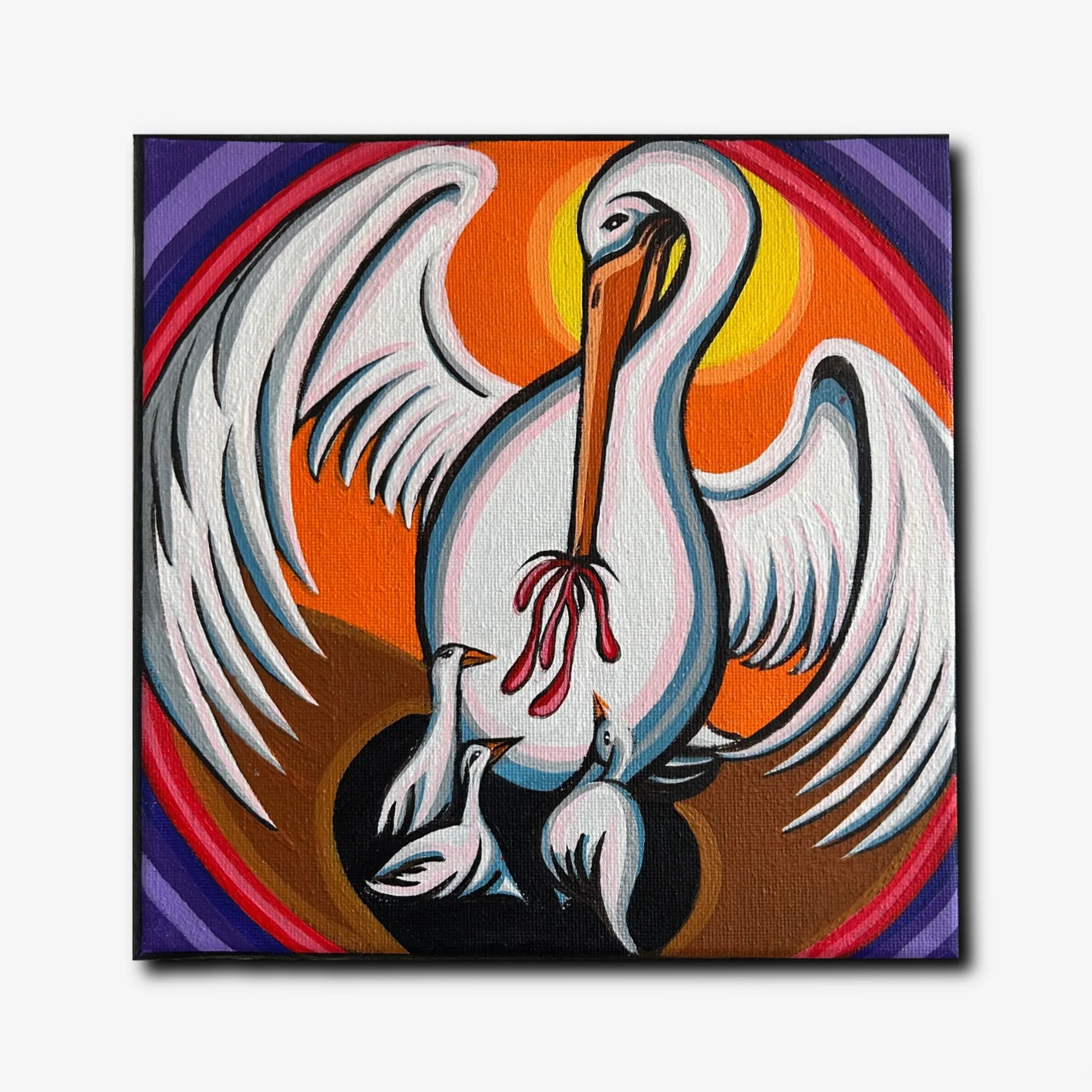 Image 1 of 1